
Why website localization is bigger than translation
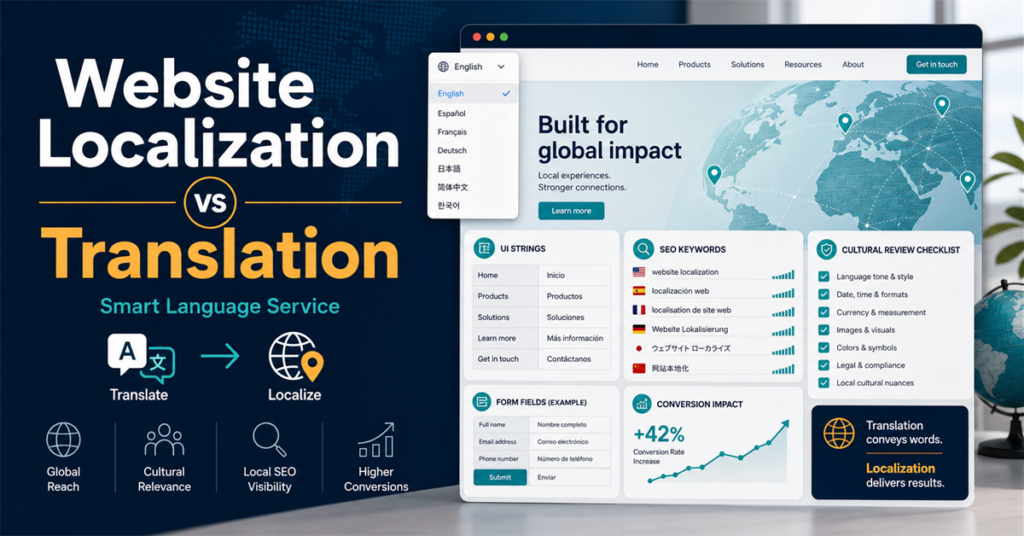
Website localization vs translation is a common confusion for teams entering new markets. Translation changes words from one language to another. Localization makes the whole page work for the buyer in that market: search intent, terminology, UI strings, form fields, proof points, legal language, payment expectations, cultural tone, and conversion paths.
This difference matters because a website is not a document. It is a sales interface, a support interface, and often the first trust signal a global customer sees. A translated page can be grammatically correct and still fail if the headline does not match local search behavior, if the call to action feels too aggressive, if examples do not fit the market, or if the form asks for information users are reluctant to provide.
For language service buyers, the practical question is not whether translation is needed. It is where translation is enough, where localization is required, and how to scope the work so quality, SEO, and conversion improve together.
Translation protects meaning; localization protects performance
Translation focuses on semantic accuracy. The translator preserves the meaning of the source text, uses correct grammar, and chooses natural target-language phrasing. This is essential for product descriptions, help articles, technical specifications, and policy text.
Localization goes further. It asks whether the page performs its business function in the target market. Does the title match the keyword people actually search? Does the value proposition address a local pain point? Do testimonials, industries, currencies, date formats, units, and examples feel relevant? Are buttons, forms, menus, and error messages clear in the target language?
A simple rule is useful: translate content that mainly informs; localize content that must persuade, convert, rank, or guide action. Home pages, service pages, pricing pages, landing pages, lead forms, product onboarding, and SEO articles usually need localization decisions, not only sentence-level translation.
SEO is one of the first places teams miss the difference
SEO localization begins before translation. A literal source keyword may not be the search term used by buyers in the target market. English teams may optimize for “data annotation services,” while another market may search more often for task-specific wording such as image labeling, speech data labeling, or AI training data preparation. The localized page should be built around local search intent, not only the source-page keyword.
This affects title tags, H1s, meta descriptions, headings, internal links, anchor text, FAQ wording, and the examples inside the body. If these elements are simply translated, the page may read well but fail to match demand. Local SEO also requires consistent service names, readable slugs where possible, and clean canonical handling so search engines understand which page should rank.
For multilingual websites, teams should also review hreflang, canonical URLs, sitemap inclusion, page speed, image alt text, and duplicate content risk. A localized page is not finished when the copy is translated; it is finished when search engines and users can both understand its purpose.
UI strings and layout create hidden quality problems
Website copy lives inside a design system. A phrase that works in English may become much longer in German, Spanish, Korean, or Japanese. Buttons, tabs, menu items, form labels, and mobile cards can break if the localization team does not see the interface. This is why website localization should include layout review, not only text delivery in a spreadsheet.
Short UI strings need special attention because they carry a lot of function in few words. “Submit,” “Get started,” “Request a quote,” and “Talk to sales” can have different levels of formality and pressure in different markets. Error messages and validation text also need clarity: users should know what went wrong and how to fix it without feeling blamed.
Before publishing, review the localized website on desktop and mobile. Check line breaks, button width, navigation wrapping, image-text overlap, truncation, form labels, and reading order. A technically accurate translation can still damage trust if the page looks broken.
Cultural fit is not decoration
Cultural adaptation is often treated as a luxury, but it is part of conversion quality. Some markets respond well to direct benefit-led headlines; others prefer proof, process, or risk reduction. A case study from one region may not persuade buyers in another. Even small choices such as honorifics, tone, examples, and industry references affect whether a page feels local or imported.
Localization should identify what must stay globally consistent and what can be adapted. Brand names, regulated claims, and approved terminology may need strict consistency. Examples, opening hooks, FAQs, testimonials, and calls to action may need market-specific adjustment. The best localization briefs define this boundary before production begins.
For B2B services, cultural fit often means reducing uncertainty. Buyers want to know how the service is managed, how quality is measured, how privacy is protected, and how communication works across time zones. A localized service page should answer those questions in a way that fits the market’s decision style.
Forms, compliance, and trust signals affect conversion
Forms are a frequent localization blind spot. Required fields, phone number format, address format, company registration fields, privacy consent, and file-upload expectations differ by market. If a translated lead form keeps the wrong assumptions, qualified buyers may abandon it.
Compliance language also needs market review. Cookie notices, privacy summaries, data transfer statements, accessibility claims, and industry certifications should not be translated casually. They must reflect what the company can actually support in that market. This is especially important for AI data, translation, transcription, subtitle, DTP, and MTPE projects where client files may include confidential or regulated content.
Trust signals should be localized as well. Certifications, service coverage, language pairs, industry experience, security practices, and client examples should be ordered according to buyer concerns. A page selling AI data services may need stronger privacy and QA proof; a page selling subtitle translation may need faster examples of timing, readability, and platform delivery.
How to scope a website localization project
Start by separating page types. Service pages, landing pages, blog articles, legal pages, UI strings, forms, and help content do not need the same level of adaptation. Assign each page a quality level: translate, localize, transcreate, or legal review. This prevents over-editing low-risk pages and under-editing high-value pages.
Next, prepare a localization kit. Include source URLs, target markets, buyer personas, SEO keywords, glossary, brand voice, approved claims, screenshot context, character limits, form requirements, and examples of pages that already perform well. If the website uses a CMS, define who uploads content, who reviews previews, and who approves final publishing.
Finally, build a QA workflow. Linguistic QA checks accuracy and style. Functional QA checks links, forms, layout, mobile rendering, and metadata. SEO QA checks titles, descriptions, headings, canonical URL, internal links, alt text, and sitemap visibility. Conversion QA asks whether the page answers the buyer’s next question.
Practical checklist before publishing
- Confirm target-market keywords before writing metadata and headings.
- Use approved terminology for services, industries, and deliverables.
- Review UI strings inside the actual layout, especially mobile.
- Localize examples, proof points, forms, and calls to action where needed.
- Check privacy, consent, cookie, and data-handling language.
- Verify canonical tags, internal links, image alt text, and sitemap inclusion.
- Ask a native reviewer to read the page as a buyer, not only as a linguist.
Related reading: our guide to technical translation cost drivers explains why scope changes affect pricing, while our MTPE quality guide shows how quality levels should match risk and publication channel.
How Smart Language Service helps
Smart Language Service supports website localization with translation, market-aware editing, multilingual SEO review, UI string QA, DTP and layout checks, subtitle and multimedia localization, and MTPE workflows for large content volumes. For global teams, we help turn translated pages into pages that are understandable, trustworthy, searchable, and ready to convert.
The strongest website localization projects begin with a clear business goal. Once the target market, page purpose, and quality level are defined, localization becomes a repeatable growth process rather than a last-minute translation task.