Why transcription services for AI training data are different from ordinary business transcription
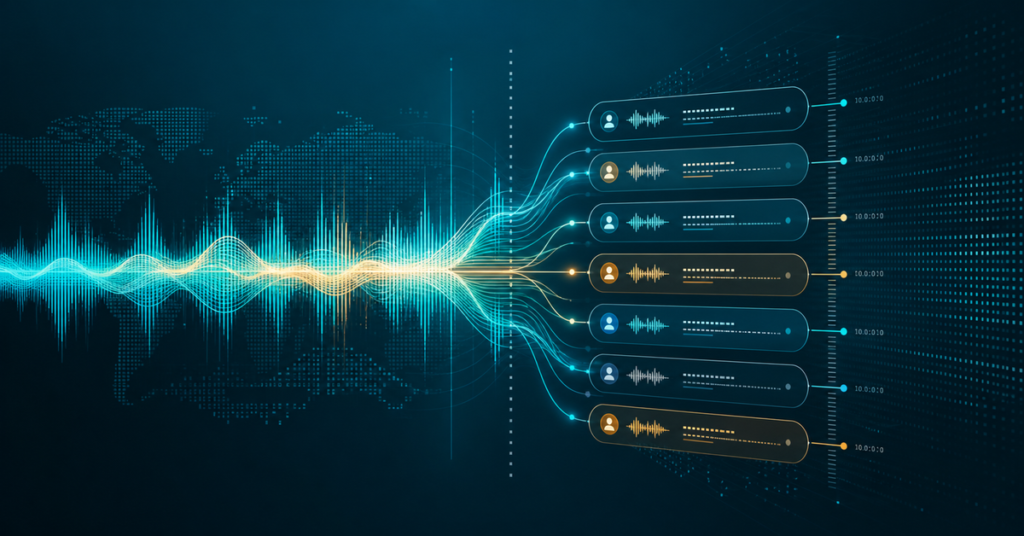
Transcription services for AI training data should not be treated as a simple text conversion task. In a normal business transcription project, the output may only need to be readable enough for documentation, meeting notes, or archive search. For AI training data, the transcript becomes structured supervision for downstream tasks such as ASR training, speech analytics, speaker diarization, keyword spotting, intent modeling, or multilingual conversational systems.
That difference changes what buyers should specify. The useful question is not only whether the words are correct. Buyers also need to define how the transcript handles timestamps, overlapping speech, hesitations, non-speech events, domain terminology, code-switching, and speaker changes. A transcript that looks acceptable to a human reviewer can still be weak training data if those rules are inconsistent.
This is why transcription planning should sit next to broader dataset design. Teams that already care about speech data collection for low-resource languages and voice data consent and privacy usually recognize that the usefulness of a speech dataset depends on both collection quality and annotation discipline. Transcription is part of that same production system.
Start with the training objective before writing the transcription brief
A common buying mistake is to request transcription first and clarify the machine learning purpose later. The stronger sequence is to define what the model must learn and then write the transcript specification around that objective.
If the dataset will train automatic speech recognition, word-level accuracy and timestamp consistency may matter most. If the dataset will support speaker diarization or call analytics, speaker turns, overlap handling, and speaker labels become more important. If the project involves multilingual customer support or field recordings, the brief may need rules for code-switching, named entities, accent variation, and background noise.
The lesson is straightforward: the transcript format should reflect model use, not vendor habit. A general template reused across every speech project often creates hidden mismatch between the delivered transcripts and the real training objective.
Accuracy has to be defined beyond a generic quality promise
Buyers often ask for high accuracy, but that phrase is too vague for AI training data. Transcription services for AI training data need a measurable definition of accuracy that fits the project.
For some projects, lexical accuracy is the primary goal. For others, the crucial issue is whether numbers, product names, medical terms, or abbreviations are captured consistently. In conversational datasets, disfluencies may need to be preserved because they affect how users really speak. In other datasets, cleaned text may be more useful if the target task focuses on semantic intent rather than acoustic detail.
This is where the provider should explain what will be preserved, normalized, or excluded. Teams should decide how to handle filler words, false starts, repeated words, profanity, unintelligible audio, partial words, and uncertain segments before production begins. Undefined accuracy rules usually become rework later.
Timestamps determine whether the transcript is useful for alignment and model training
Many buyers underestimate how much timestamps affect dataset value. In transcription services for AI training data, timestamps are not just a convenience for playback. They often determine whether the transcript can support forced alignment, segment extraction, subtitle-like synchronization, utterance slicing, or time-based review workflows.
The buyer should define the timestamp granularity upfront. Some use cases only need segment-level timestamps. Others require sentence-level or word-level timing. The right choice depends on the model pipeline, the review cost, and how tightly audio and text must align downstream.
Teams should also ask how timestamp drift is monitored. A transcript can contain mostly correct words and still become unreliable if segment boundaries slide, merge, or split inconsistently. For training data, timing errors can be just as damaging as spelling errors because they break alignment logic across the dataset.
Speaker labels are essential when conversations matter
Speaker labels are often treated as a formatting preference, but for conversational AI they are a structural requirement. Contact center data, interviews, meetings, telehealth calls, and multi-speaker field recordings all become more valuable when speaker turns are marked consistently.
A strong specification should define whether labels are generic such as Speaker 1 and Speaker 2, role-based such as Agent and Customer, or identity-linked when the dataset and privacy model allow it. It should also explain how to label interruptions, crosstalk, off-mic speakers, and uncertain speaker changes.
Without these rules, two reviewers can produce readable transcripts that encode dialogue structure differently. That inconsistency is costly for speaker diarization, summarization, turn-taking analysis, and supervised conversational training. Buyers who care about multi-speaker learning should treat labeling rules as core metadata, not cosmetic formatting.
Noise, overlap, and language mixing should be written into the guideline
Real speech data is messy. Audio may contain background noise, clipped words, regional accents, non-native speech, music, mechanical sounds, overlapping speakers, or rapid language switching. Transcription services for AI training data should not hide these realities behind a clean-looking transcript.
Instead, the guideline should specify how to mark non-speech events, when to flag low-confidence segments, how to represent laughter or pauses if needed, and how to transcribe code-switched content. This is especially important for multilingual AI teams, because language mixing can carry real product meaning in customer support, social audio, and international operations.
The operating principle is similar to multilingual text data collection for LLM evaluation: realistic data is valuable only when edge cases are captured consistently enough for the model and the reviewers to interpret the same way.
QA for transcription services for AI training data should be layered
Final-stage spot checks are not enough for large transcription programs. A stronger workflow starts with pilot audio, calibrates reviewers on difficult cases, samples output continuously, and feeds errors back into the written guideline.
Buyers should ask how the vendor measures disagreement, how domain terminology is escalated, how timestamp issues are audited, and how many files are rechecked by senior reviewers. In complex domains such as healthcare, finance, manufacturing, or legal services, reviewer calibration may matter as much as raw typing accuracy.
It is also useful to track error categories separately. Word substitution, omission, timestamp drift, speaker-switch errors, and formatting inconsistencies do not create the same downstream risk. When QA is category-based instead of purely pass-fail, teams can correct the process more quickly.
Questions buyers should ask before choosing a transcription partner
Before approving a vendor, buyers should ask operational questions that reveal whether the provider understands AI data use instead of only conventional transcription delivery.
- What transcription style guide is used for hesitations, partial words, and unintelligible audio?
- Are timestamps segment-level, sentence-level, or word-level, and how is drift checked?
- How are speaker labels assigned, reviewed, and corrected?
- How are code-switching, named entities, and domain terminology handled?
- What QA sampling rate is used, and which error categories are tracked separately?
- How are difficult audio files escalated and how are rule updates communicated during production?
These questions matter because the value of transcription services for AI training data is not only speed. It is whether the dataset can be trusted by downstream model, analytics, and evaluation teams.
How Smart Language Service supports transcription services for AI training data
Smart Language Service supports transcription services for AI training data with multilingual operations, practical style-guide design, timestamp and speaker-label workflows, domain-aware QA, and scalable review management. We help buyers turn raw speech data into structured, auditable training assets that fit real AI objectives.
For teams building ASR, speech analytics, diarization, voice assistant, and multilingual conversational datasets, the strongest results usually come from aligning collection scope, privacy planning, transcript rules, and QA before large-scale production starts. When those elements are designed together, transcription becomes a reliable data layer instead of a cleanup task at the end.